

You have decided to start knitting and the time has come to buy some knitting needles.
You are faced with the terms: circular needles, straight needles, double-pointed needles, cable needles, etc.
How to find your way around?
Here's the second article to help you sort through the knitting jargon and help you choose what's best for you!
You've decided to start knitting. You've already bought some yarn or are ready to do so. You've already chosen a pattern or are ready to do so. Now you need to buy the basic materials, including knitting needles.
You are faced with a large choice of needles: interchangeable, circular, straight... which ones to choose?
To begin, you'll need to distinguish between the two main types of knitting needles: straight and circular. Once you've mastered these two broad categories, you'll notice that there are several subcategories and accessory needles that you can find online or at your favorite haberdashery.
Let's start with straight needles.
1. Straight needles
1.1. Single-pointed straight needles
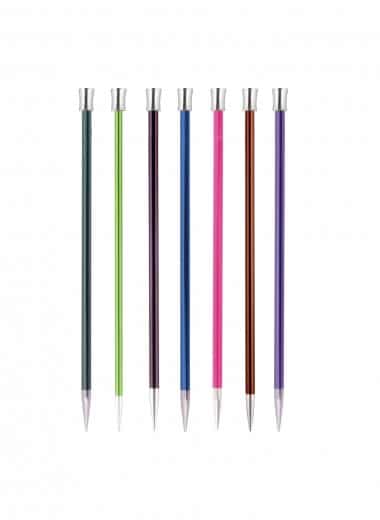
Like many of you, when I first started knitting, this is what I thought of when I thought of knitting needles. This was typically what my grandmother used and what I used before discovering circular needles.
They are straight, with a point on one side and a ball on the other to prevent the stitches from falling off the needle. They can measure from 25 to 40 cm.
They are available in metal, wood, plastic (if you want to know more, I advise you to read This item on the materials used for knitting needles).
1.2. Double pointed needles

Double-pointed needles are very similar to single-pointed needles. Except they have two points, not one (pretty obvious, right?)
But that's not really what makes them special, double-pointed needles are shorter: generally, they measure 10 to 20 cm. and they are sold in sets of 4 to 5 needles.
As with double-pointed needles, you will find them in different materials: wood, metal, bamboo, etc.
The use of double-pointed needles is particular: they are used to knit small circumferences in the round and are mainly used to knit socks! (you can obviously knit a sleeve or a hat but I have rarely seen them used in this case except to finish the top of a hat when there are only a few stitches left).
1.2.3. Bent double-pointed needles

Soft double-pointed needles have recently appeared on the market. They serve the same purpose as double-pointed needles, but are sold in sets of 3 instead of 5.
They make it easier to use needles for knitting small circumferences because they have a very small cable in their center, which makes them flexible and allows you to use only two needles for stitches and a third for knitting.
Personally, I was won over by these needles after a little time of adaptation. Especially for knitting socks, although it is not uncommon for me to return to double-pointed needles when I want to knit small circumferences.
2. Circular needles
Circular needles are very similar to the previous needles: two points joined by a flexible cable of variable length.
Some circular needles have a cable-needle junction that rotates on itself. I strongly recommend choosing this option if you have the choice. It will make your life easier and prevent your cable from getting tangled when you're working with Magic Loops or the sleeves of a sweater.
When I discovered circular needles, it completely changed my outlook on knitting: no more need to knit flat and sew a sweater, everything can be done in one piece! No more stress when you have a very large number of stitches on your needles!
Circular needles have now become my favorite tool for knitting and I haven't used my straight needles for many years.
2.1. Fixed circular needles

Fixed circular needles are circular needles with the cable attached to the needles.
You will not be able to change the cable length with these needles. So if in a pattern you are asked to take a shorter cable length, then you will have to take another pair of circular needles or use the method of Magic Loop.
I have very few fixed circular needles. Either because they were given to me, because they were a pair bought in a hurry, or because I wanted to test the cable and needles before investing in a kit.
2.2. Interchangeable circular needles

Interchangeable circular needles are completely identical to fixed circular needles: they consist of two points and a cable made of different materials.
The main difference is that these needles screw onto a cable, so you can change the cable length while knitting.
So you can buy a single pair of needles and several cables to obtain different circumferences.
There are also circular needle kits with three or four cables that fit multiple needle sizes. If you're hooked on knitting, it's worth considering purchasing a kit. While it's a significant investment initially, it will serve you well for many years to come.
A quick note: Circular needles are made from the same materials as straight needles, but you also need to consider the cable material. This can be hard plastic, soft plastic, or even metal-reinforced plastic cable.
Personally, I prefer a relatively soft cable for knitting large pieces and a stiffer cable for sleeves or small circumferences (when I'm not using double-pointed needles).
Also pay attention to feedback from experienced knitters: for example, I have a set of circular needles that I really like, but unfortunately, I have to regularly buy cables because the plastic of the cable ends up kinking and eventually breaking.
2.3. Short circular needles
2.3.1. Short circular needles of 23 cm

The 23 cm short needles are fixed circular needles with a very short cable.
They were created as an alternative to double pointed needles, therefore for knitting small circumferences.
They require some dexterity to hold them.
Personally, I have used them but very little because I have to hold them with my fingertips to be able to knit and so it completely changes my way of knitting and it becomes painful after a certain time of knitting.
2.3.2. 30 cm short bent circular needles

These needles are very similar to the previous ones, but they are slightly longer and have an angled tip. In my opinion, they are much more ergonomic than the previous needles.
They are my favorite needles for knitting sweater sleeves.
2.3.3. Interchangeable short needles
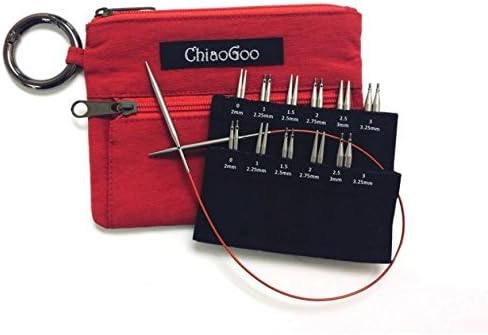
Chiaogoo recently released an interchangeable kit of short needles. This eliminates the need to invest in multiple needles of different lengths if the first short needles are suitable for you.
I hope one day Chiaogoo will offer the same option for bent needles.
3. Others
3.1. Cable needles

And finally, I have to tell you about cable needles.
Needles that are not really needles but rather an accessory.
These needles are very short needles, usually bent. They allow you to slip stitches onto them to put them on hold or to cross them when making cables.
They will be essential when you move on to the next level of knitting and tackle cables.
You will find them in different forms: straight, angled, plastic, wooden, etc.
That's it for today, I hope this information has already helped you clarify certain things and guide you towards one type of needle or another.
If you want to know a little more, I share my knowledge with you in the YouTube video below.
If you would like to share this article with others, please feel free to share it via social media (just click the buttons below).
See you soon,
Christelle


Comments 2
Another discovery! I'm a fan 😊
Author
Thank you 🙂