

Today, let's tackle the touchy subject: the sample!
Making a swatch is one of the most important things to do when you start a large-scale knitting project or a project where measurements are really important, such as a sweater, socks, or a hat.
This will allow you to familiarize yourself with the wool used, to know how it behaves when blocking, to know if it corresponds well to what is expected in the pattern that you are going to use, it also allows you to know if the result obtained pleases you or corresponds to what can be expected for a sweater or any other knitted piece.
This will save you a lot of hassle and wasted hours unraveling a sweater that ultimately doesn't suit you because the measurements aren't correct or simply because the result doesn't match what you had hoped for!
Do you need any more convincing to make samples? Yes? Let's go!

1. It saves you time!
When you're a product knitter (project knitter*), it's sometimes difficult to set aside time to make a sample because you only want one thing: to cast on the stitches and start knitting!
*I discuss the topic of product and process knitters in this video
However, this step is very important and it will save you time later because it will prevent you from having to unravel because the gauge turned out to be inaccurate or because the wool, however beautiful it may be in skein or ball, was not the wool intended for this project.
So I recommend you spend an hour of your time making your sample, washing it, and letting it dry overnight. I understand that this can be very frustrating at times, but trust me, it's worth it!
2. How to knit a flat swatch?

The purpose of a sample is to ensure that the result of the "fabric" obtained is as close as possible to what you expect but also that the number of stitches and rows corresponds to the sample recommended in the pattern you have chosen.
So how do you make a sample properly?
It is important to make your sample in the same conditions as you will knit your project, therefore same needles of the same composition (the use of wood or metal can affect the size of your sample).
It is also important to wash and/or block your sample in the same way that you will maintain your knitting: if you are machine washing, put your sample in the machine or if you are steam blocking, steam block your sample.
Then for a flat sample, I advise you not to limit yourself to the recommended dimensions of 10 cm * 10 cm.
Indeed, often the stitches at or near the selvage are slightly distorted, so this can affect your sample.
A swatch of 15 cm x 15 cm or 20 cm x 20 cm is best. If you're worried about running out of yarn, remember you can always unravel it and save the yarn.
To get something fairly representative, I advise you to do a few rows of garter stitch before starting the stitch recommended in the pattern and which will help you determine the number of rows and stitches as well as making a border in garter stitch or 1*1 ribbing.
Once your swatch is finished, don't measure it yet, resist the temptation to measure after the stitches have been cast off!
Let him get comfortable and block him/wash him
3. How to knit a swatch in the round?

In the previous paragraph, I gave you some tips for making a correct swatch when knitting flat. But how do you make a swatch when the project will be knitted in the round?
Will a flat sample do the trick? Well, maybe, but definitely not!
Indeed, knitters often do not knit in the same way in the round as they knit flat. This is also important to know because if your knitting requires flat knitting (for example for the body of a cardigan) and also in the round (for the sleeves), your sleeves may be too narrow or too wide.
To knit in the round, you will cast on the stitches as for a flat swatch but you will not join in the round.
You will slip all your stitches back onto the needle so that you are always knitting (you will never turn your work).
A long yarn will be passed behind the knitting, make sure you don't pull the yarn too much so that you have a sufficiently flexible tube.
Stitches along the selvages will often be stretched, so feel free to pull the yarn to make the stitch tighter.
You will then cut at the back of the sample in the middle of the floating threads.
If you're worried about running out of yarn, I recommend knitting in the round so that your knitting forms a tube with a circumference of 25 to 30 cm. Cast off the knitting as usual, block it/wash it as before.
4. Block your samples

Then block your sample as you would block your finished project: iron, steam, or wash.
You will then lay it flat to let it dry and if necessary you can use locking cables, needles or combs.
Let it dry completely and again, resist the temptation to measure it. Especially if your yarn is quite tightly plied.
This is because this type of wool tends to shrink on itself and therefore this will affect your swatch and finished project.
It is best to knit the swatch and wait until the next day to measure it.
5. Measure your samples

Once the sample has been blocked, washed, dried, and allowed to rest, it is time to measure it.
To do this, you will place it flat on a flat surface. You will use a rigid ruler or a square such as this one:
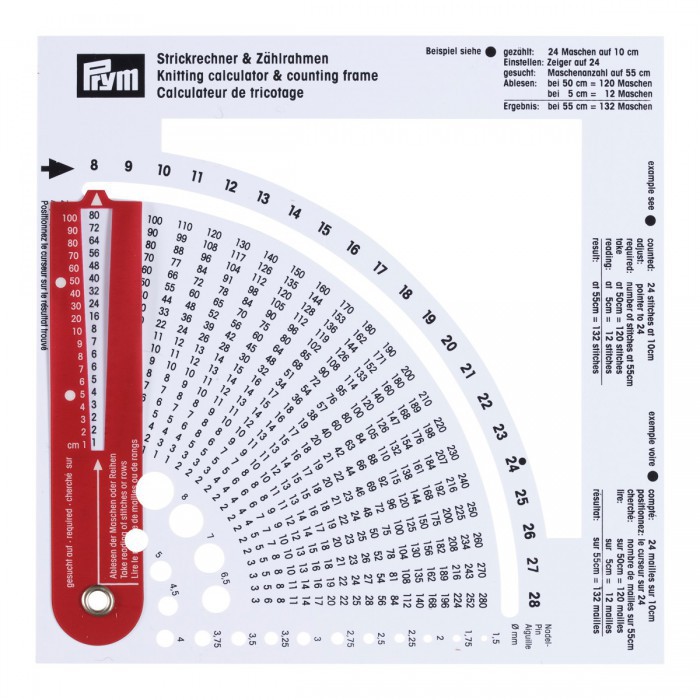
You will count horizontally the number of stitches per 10 cm and vertically the number of rows.
If your swatch is a lace or cable repeat, I recommend measuring the entire repeat (e.g. 24 lace stitches for 12cm and 45 rows for 15cm). Then divide to get your swatch of 10cm * 10cm.
For our example, this will give a swatch of 24 sts / 12 cm x 10 cm, which gives you 20 sts. And a swatch of 45 rows / 15 cm x 10 cm which gives you 30 rows. You will therefore obtain a swatch of 20 sts / 30 rows for 10*10.
6. Compare your sample to the expected sample
Once you have your sample, it is time to check if it matches the recommended sample.
If so, you've found the right needles!
If not, what should you do? There are several scenarios to consider.
- the number of meshes in the sample is higher than the recommended number of stitches. You will therefore need more stitches to make 10 cm. This will affect the size of your finished project. For example, in a pattern, you are asked for a gauge of 20 stitches and you have 180 stitches at the bust, your knitting circumference at the bust will be 90 cm. If your gauge is 22, you will only have 82 cm left! So one size smaller than the size you are knitting!
- the number of meshes in the sample is lower than the recommended number of stitches. You will therefore need more stitches to make 10 cm. This will affect the size of your finished project. For example, in a pattern, you are asked for a gauge of 20 stitches and you have 180 stitches at the bust, your knitting circumference at the bust will be 90 cm. If your gauge is 18, you will only get 100 cm! So one size larger than the size you are knitting.
- the number of rows in the sample is higher than the recommended number of rows. You will therefore need more stitches to make 10 cm. This will affect the size of your finished project. For example, in a pattern, you are asked for a gauge of 30 rows and you have 60 rows of raglan, your armhole height will be 20 cm. If your gauge is 32, you will only have 18.75 cm left! So one size smaller than the size you are knitting!
- the number of rows in the sample is lower than the recommended number of rows. You will therefore need more stitches to make 10 cm. This will affect the size of your finished project. For example, in a pattern, you are asked for a gauge of 30 rows and you have 60 rows of raglan, your armhole height will be 20 cm. If your gauge is 28, you will get 21.5 cm! So one size smaller than the size you are knitting!
You can therefore see that respecting the recommended sample is of fundamental importance in the completion of a project.
In this case, how to make the gauge match: if your number of stitches and rows is less than the recommended gauge, you will knit with needles of a lower number and you will increase your number of stitches and rows every 10 cm.
If your number of stitches and rows is higher than the recommended gauge, you will be knitting with needles one size larger and will have fewer stitches and rows per 10 cm.
You can of course also play with the material of the needles used, the material mainly affecting the number of rows (depending on whether the needles slide or not) or sometimes add one or two rows if only the sample in rows does not correspond but this will be very dependent on the pattern in question (in some patterns, the sample in rows is fundamental).
And if despite all your attempts, you do not obtain the desired gauge, it is either time to choose another wool or to call on your adventurous soul and adapt the pattern!
With these few tips, you're now ready, I hope, to start more ambitious projects. And remember, it's never a good idea to skip samples!
If you would like to share this article with others, please feel free to share it via social media (just click the buttons below).
See you soon,
Christelle


Comments 1
Very informative! Thanks for the explanations.
Fabienne